Last updated: June 2026
On summer nights, your CCTV camera becomes a glowing beacon that draws every flying insect within 50 metres. Moths spiral around the lens. Midges form shimmering clouds. Beetles crawl across the sensor. Your motion alerts fire all night, your footage shows nothing but insect blobs, and your AI analytics classify moths as potential intruders. The CCTV industry knows this happens. They simply do not talk about it.
Why Insects Are Drawn to IR
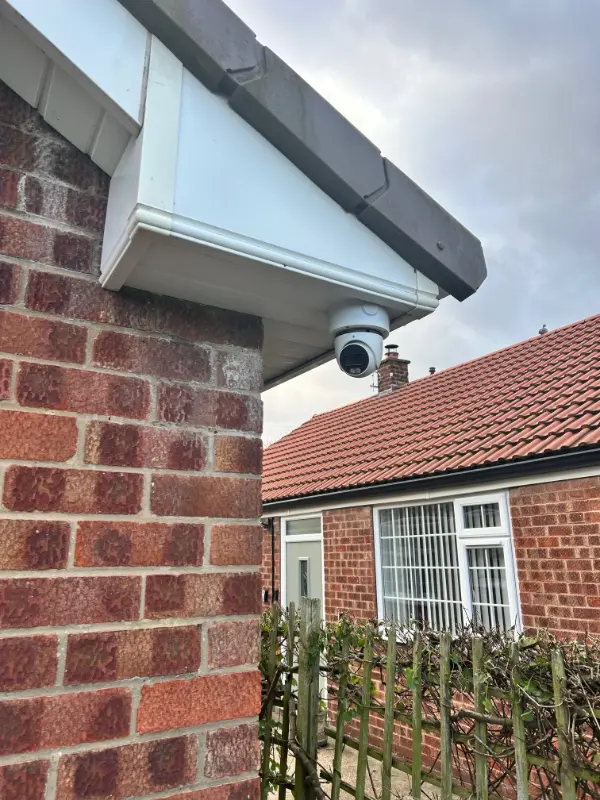
Most CCTV cameras use 850nm infrared LEDs for night vision. This wavelength is invisible to humans but highly visible to many insects. To a moth, an active IR LED is a miniature sun — a navigational beacon that overrides their natural behaviour. Entomologists have documented that 850nm IR disrupts moth flight patterns at distances of up to 30 metres.
Midges are particularly attracted to the heat and IR combination. The camera housing warms up several degrees above ambient temperature during operation. Midges detect this warmth as a sign of a warm-blooded animal and swarm toward it. The camera is not just a light source — it is a counterfeit life form.
Why the Industry Pretends This Does Not Happen
CCTV manufacturers cannot mention the insect problem in their marketing because doing so would acknowledge a fundamental design limitation. You will not find 'May attract swarms of flying insects' in any product specification. Instead, manufacturers silently add digital noise reduction (DNR) algorithms that attempt to filter out insect-induced artefacts, but these algorithms reduce image quality across the entire frame.
The problem is most severe for cameras with IR range exceeding 20 metres. High-power IR arrays create a larger halo of insect-attracting light. A camera that can illuminate a 30-metre garden is simultaneously creating a 30-metre moth magnet.
The Separation Fix That Actually Works
The single most effective engineering solution is to separate the IR illumination from the camera lens physically. Mount an external IR illuminator 1-3 metres away from the camera, positioned to light the scene from a different angle. The insects congregate around the illuminator, not the camera lens. The camera captures the scene without insects crawling across it.
This approach has the additional benefit of improving image quality because off-axis IR illumination creates better contrast and fewer hot spots than on-camera IR.
Seasonal Management for UK Homes
Insect activity follows UK seasons. May-June: midge season peaks. July-August: moth season. September-October: crane flies and late-season beetles. November-April: minimal insect activity.
During peak seasons, increase your maintenance frequency. Clean the lens housing every 2-3 days. Consider turning off IR for 1-2 hours around dusk when insect activity is highest, relying on dusk-level ambient light instead. If your camera supports it, schedule IR to disable during dawn and dusk transitions when insects are most active.
Video: H.265 (HEVC) vs H.264 (AVC) Compression: Explained! — a practical walkthrough of the technology discussed in this guide.

Frequently Asked Questions
1. Does 940nm IR attract fewer insects than 850nm?
Answer: Yes. 940nm is less visible to insects than 850nm because insect photoreceptors have reduced sensitivity at longer wavelengths. Switching to a 940nm camera or adding a 940nm external illuminator can reduce insect attraction by 60-70%. For more detail, see Does Warehouses and Logistics CCTV reduce insurance premiums in 2026? UK guide. Also read our related guide: Why Your Neighbour's Ring Doorbell Is Legally Filming You: The Fairhurst v Woodard Rule Every UK Homeowner Misses. Browse our comprehensive CCTV knowledge base at CCTV Systems Guide. Official UK guidance on this topic: GOV.UK.
2. Will turning off IR and using white light reduce insect problems?
Answer: White light attracts different insects. Moths are strongly attracted to white light. LED white light is less attractive to midges but more attractive to moths. The net effect depends on your local insect population. For more detail, see Can I record faces from the public pavement outside my pub entrance without specific consent? UK Pubs, Bars and Restaurants CCTV rules explained 2026. Also read our related guide: BNC Connector Rot: The Single Most Common Failure Point in Analogue CCTV and Why It Always Fails at 2 AM.
3. Can insect repellent or insecticide near the camera help?
Answer: Household insect repellent sprayed on the camera housing can deter crawling insects for a few days. Spray the housing, not the lens. Insecticide should not be used near camera electronics due to potential chemical damage to seals and gaskets. For more detail, see How to install CCTV for Dental and Medical Practices - UK step by step guide 2026. Also read our related guide: Why Your CCTV System Eats Hard Drives: The Surveillance-Grade vs Desktop Drive Truth.
4. Why do my motion alerts fire all night during summer but not winter?
Answer: Insects are seasonal. In UK winters, insect activity drops to near zero. The difference between summer and winter false alert rates can be 100:1. This is normal and does not indicate a change in your camera's detection settings. For more detail, see Does Schools and Education Settings CCTV reduce insurance premiums in 2026? UK guide. Also read our related guide: Why Rural CCTV Cameras Die Faster: The True Cost of UK Countryside Installation Nobody Advertises.
5. Does the insect problem affect all camera brands equally?
Answer: Yes. The insect attraction is a function of IR wavelength and heat output, not brand. A Hikvision camera attracts the same insects as a Dahua, Reolink, or Uniview camera under the same conditions. The problem is physics, not brand choice. Also read our related guide: The Dawn Fog Problem: Why Your UK CCTV Camera Goes Blind Every Morning Between 5 and 7 AM.
Conclusion
The difference between a security system that works and one that frustrates is understanding the real-world behaviour of cameras, cables, and the environment they operate in. Manufacturers sell specifications. Installers solve problems. The questions above represent the issues that UK homeowners and businesses actually face — the ones the spec sheets do not mention.
Article by Gary Pearce, qualified security systems engineer. For a free security assessment, visit gary-pearce-home-services.pages.dev. This guide was last updated June 2026. Verify current UK regulations with the ICO.