Last updated: June 2026
Your camera specification says 'WDR 120dB' in bold letters. You installed it facing a scene with bright sunlight and deep shadow. The image shows a blown-out sky and pitch-black faces. The specification lied. Not intentionally, but through a marketing practice that blurs the line between hardware capability and software trickery. True Wide Dynamic Range requires specific sensor technology. Most cameras under GBP 200 do not have it.
How WDR Actually Works
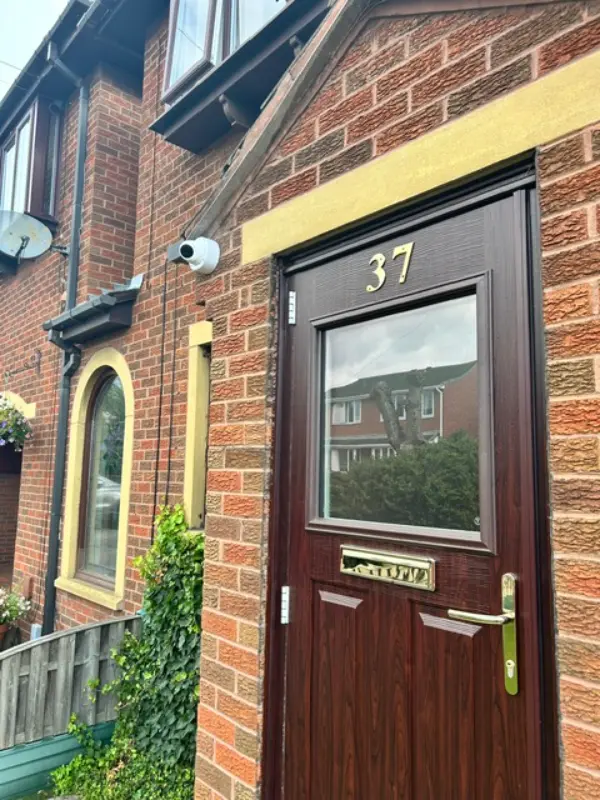
Wide Dynamic Range is the camera's ability to capture detail in both bright and dark areas of the same scene simultaneously. A scene with 120dB dynamic range means the brightest area is 1,000,000 times brighter than the darkest. The human eye handles this effortlessly. Camera sensors have a native dynamic range of approximately 60-70dB.
True WDR (also called True WDR or Super WDR) captures two or more exposures of the same frame — one short (for bright areas) and one long (for dark areas) — and combines them into a single image. This requires a sensor capable of sequential high-speed exposure readout. Budget sensors cannot do this.
Digital WDR: The Marketing Mirage
Digital WDR (also called DWDR or Digital WDR) applies a gamma curve to the single exposure. It brightens dark pixels and dims bright pixels using image processing. This is not true dynamic range expansion — it is contrast adjustment applied after the sensor has already clipped the highlights and crushed the blacks.
Digital WDR cannot recover detail that was never captured. If the bright sky was already blown out (all pixels at maximum value), digital WDR cannot create detail where there is none. The specification 'WDR 120dB' on a camera without multiple-exposure sensor technology is misleading at best.
How to Tell the Difference
Look at the sensor specification, not the WDR number. A camera with a Sony STARVIS IMX335 sensor supports true WDR via multiple exposures. A camera with a generic OV sensor listed as 'DWDR' or 'Digital WDR' is applying post-processing only. The giveaway is in the fine print: '120dB WDR' without qualification is suspicious. '120dB True WDR' or '120dB Super WDR' is more credible.
For practical verification: point the camera at a scene with a bright window and dark interior. True WDR shows detail both outside the window and inside the room. Digital WDR shows either a properly exposed interior with a blown-out window, or a visible exterior with a pitch-black room.
The North-Facing House Problem
UK homes with north-facing frontage present a specific WDR challenge: the front of the house receives no direct sun, but the street beyond receives full sunlight. The camera's exposure must handle both. Without true WDR, you choose: expose for the house (white street) or the street (black house).
True WDR cameras with Sony STARVIS or equivalent sensors solve this. Digital WDR cameras in north-facing installations produce unusable footage for 4-6 hours per day. This is the single most common WDR complaint that leads to camera replacement.

Video: H.265 (HEVC) vs H.264 (AVC) Compression: Explained! — a practical walkthrough of the technology discussed in this guide.
Frequently Asked Questions
1. What is a realistic WDR expectation for a sub-GBP 150 camera?
Answer: Cameras under GBP 150 rarely have true sensor-level WDR. Expect digital WDR with 60-80dB effective range. This handles moderate contrast scenes (bright day, light shade) but fails on high-contrast scenes (direct sun + deep shadow). For more detail, see Future of Warehouses and Logistics CCTV in 2026 - UK trends and technology. Also read our related guide: Can a Tenant Install CCTV in a Rented UK Property? The Legal Maze Nobody Warns Tenants or Landlords About. Browse our in-depth home security resource at Home Security Guide. Official UK guidance on this topic: ICO.
2. Does HDR (High Dynamic Range) in cameras mean the same as WDR?
Answer: HDR and WDR refer to the same concept but HDR typically applies to photographic cameras and WDR to surveillance cameras. Some manufacturers now use 'HDR' to differentiate from older 'WDR' branding. The distinction between true and digital applies equally to both terms. For more detail, see Does Offices and Commercial Buildings CCTV reduce insurance premiums in 2026? UK guide. Also read our related guide: What Happens When You Ignore a Subject Access Request for Your CCTV Footage: The GBP 9,000 Legal Risk Nobody Takes Seriously.
3. Can I improve WDR performance by adjusting the camera's position?
Answer: Yes. Reducing the contrast range in the scene by repositioning the camera is often more effective than relying on WDR processing. Angle the camera to avoid including both deep shadow and direct sunlight in the same frame. Move the camera to include less sky. For more detail, see Can installing CCTV solely to reduce false alarms breach UK data protection law? UK False Alarm Reduction CCTV rules explained 2026. Also read our related guide: The Data (Use and Access) Act 2025: What UK Home CCTV Owners Must Know About the New Law That Changed Everything.
4. Does enabling WDR affect frame rate or recording quality?
Answer: True WDR requires the sensor to capture two exposures per frame, which can reduce the effective frame rate by up to 50%. A camera that records 25fps without WDR may drop to 12.5fps with WDR enabled. Test frame rate with WDR enabled before finalising installation. For more detail, see Churches and Places of Worship CCTV - UK legal requirements and GDPR compliance 2026. Also read our related guide: Listed Building Consent vs CCTV: The Conflicting Regulations That Trap UK Homeowners in a Legal Catch-22.
5. Is WDR more important for daytime or nighttime recording?
Answer: WDR is primarily a daytime feature. At night, IR illumination creates its own contrast problems (bright foreground, dark background), but this is not WDR. 'Night WDR' is usually digital gain adjustment, not true multi-exposure WDR, because IR sensors operate differently. Also read our related guide: Council House CCTV: The Often-Overlooked Rules That Apply to Social Housing Tenants and Landlords.

Conclusion
The difference between a security system that works and one that frustrates is understanding the real-world behaviour of cameras, cables, and the environment they operate in. Manufacturers sell specifications. Installers solve problems. The questions above represent the issues that UK homeowners and businesses actually face — the ones the spec sheets do not mention.
Article by Gary Pearce, qualified security systems engineer. For a free security assessment, visit gary-pearce-home-services.pages.dev. This guide was last updated June 2026. Verify current UK regulations with the ICO.