Last updated: June 2026
You bought an AI security camera specifically to eliminate false alerts. You enabled person detection, configured activity zones, and set appropriate sensitivity levels. Yet every Tuesday at 3 PM, your phone lights up with a 'Person Detected' alert — triggered by a white t-shirt swaying on your neighbour's washing line. Your AI camera is not broken. It is revealing a fundamental limitation in how consumer AI models are trained and what they actually detect.
How Consumer AI Models Are Trained
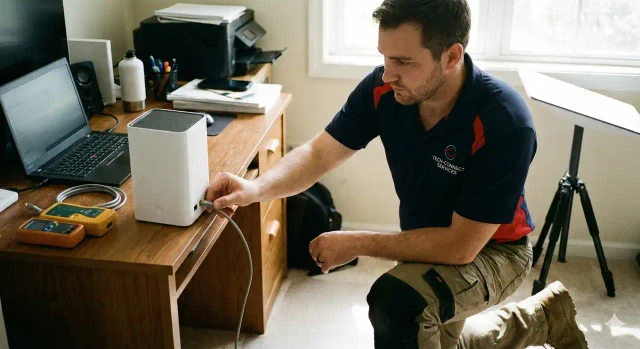
Most consumer-grade AI camera models are trained on datasets like COCO (Common Objects in Context) or custom data labelled by the manufacturer. These datasets contain thousands of images of people in various poses, clothing, and lighting conditions. What they rarely contain is images of objects that look like people but are not — like washing lines, mannequins, garden statues, or large dog breeds standing upright.
The AI model learns to identify 'person-like' shapes. A white t-shirt on a line, viewed from 15 metres away with the arms of the shirt outstretched, produces a silhouette that the model classifies as a person with 65-80% confidence. If your confidence threshold is set at 50%, the alert fires.
Why 2.8mm Lenses Make It Worse
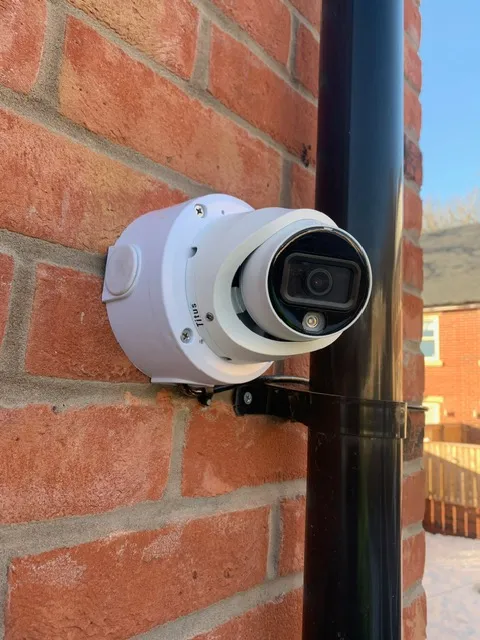
Wide-angle 2.8mm lenses capture more field of view but make objects smaller in the frame. A person at 10 metres occupies fewer pixels than on a 4mm or 6mm lens. With fewer pixels to analyse, the AI has less information to distinguish between a real person and a person-shaped object.
A 2024 study found that AI person detection accuracy drops from 94% on 4mm lenses to 71% on 2.8mm lenses at the same distance, for objects smaller than 15% of the frame height. The false positive rate tripled.
The Confidence Threshold Trade-off
Every AI camera lets you adjust sensitivity. Lower sensitivity = fewer false alerts but more missed detections. The default threshold is typically set at 60-70% confidence — a compromise that works for average installations but fails in specific environments.
To stop washing line false alerts, increase your confidence threshold to 85-90%. Test for a week. If you miss a genuine event, lower it by 5%. The optimal threshold depends on your specific environment and cannot be determined by a default setting.
What Professional Installers Do Differently
Professional alarm response centres do not rely on camera-based AI alone. They use a layered approach: camera AI identifies a potential person, then a human operator reviews the feed within 30 seconds. The human rejects the washing line instantly.
For home users, the practical fix is to use activity zones to exclude the area where the washing line is visible. If that is not possible, train your camera by using its 'teach' or 'learning' mode if available — some newer models allow you to mark a detection as a false positive and adjust their model locally.

Video: Hikvision ColourVu 3.0 - Full Review, Test & Giveaway — a practical walkthrough of the technology discussed in this guide.
Frequently Asked Questions
1. Will a better AI camera solve the washing line problem?
Answer: Not necessarily. Hikvision's AcuSense, Dahua's AI, and Reolink's AI all use similar convolutional neural network architectures trained on similar datasets. They all struggle with person-shaped objects they were not trained on. The problem is the training data, not the hardware. For more detail, see Best CCTV cameras for Pubs, Bars and Restaurants in 2026 - UK buyer guide. Also read our related guide: The 100-Metre PoE Myth: Why Your Outdoor Camera Fails at 70 Metres and How to Design Realistic Cable Runs. Browse our in-depth home security resource at Home Security Guide. Official UK guidance on this topic: NSI.
2. Does enabling vehicle detection reduce person false alerts?
Answer: No. Person and vehicle detection are independent classifiers. A washing line may trigger person detection but vehicle detection has no effect on the person classification pipeline. The two systems run in parallel. For more detail, see Best CCTV cameras for Pubs, Bars and Restaurants in 2026 - UK buyer guide. Also read our related guide: Why Your CCTV Camera Attracts Every Moth in the Neighbourhood: The Infrared Insect Magnet Problem.
3. Can I upload custom images to teach my camera?
Answer: Not on consumer-grade cameras. Enterprise systems like Milestone XProtect or Genetec allow custom model training. Consumer cameras have fixed firmware models that cannot be retrained. You can only adjust confidence thresholds and detection zones. For more detail, see Hotels and Hospitality CCTV - UK legal requirements and GDPR compliance 2026. Also read our related guide: Why Your Neighbour's Ring Doorbell Is Legally Filming You: The Fairhurst v Woodard Rule Every UK Homeowner Misses.
4. Why does the false alert only happen at certain times of day?
Answer: The washing line may only be visible during certain lighting conditions. Late afternoon sun can create backlighting that makes the silhouette more person-like by removing detail and colour information. The AI has less data to work with and misclassifies more often. For more detail, see Future of Retail Shops and Stores CCTV in 2026 - UK trends and technology. Also read our related guide: BNC Connector Rot: The Single Most Common Failure Point in Analogue CCTV and Why It Always Fails at 2 AM.
5. Does colour night vision help reduce washing line false alerts?
Answer: Colour night vision provides more information to the AI classifier, which can help reduce false positives. If your camera switches to monochrome IR at night, the loss of colour information makes silhouette-based misclassification more likely. Also read our related guide: Why Your CCTV System Eats Hard Drives: The Surveillance-Grade vs Desktop Drive Truth.
Conclusion
The difference between a security system that works and one that frustrates is understanding the real-world behaviour of cameras, cables, and the environment they operate in. Manufacturers sell specifications. Installers solve problems. The questions above represent the issues that UK homeowners and businesses actually face — the ones the spec sheets do not mention.
Article by Gary Pearce, qualified security systems engineer. For a free security assessment, visit gary-pearce-home-services.pages.dev. This guide was last updated June 2026. Verify current UK regulations with the ICO.