Last updated: June 2026
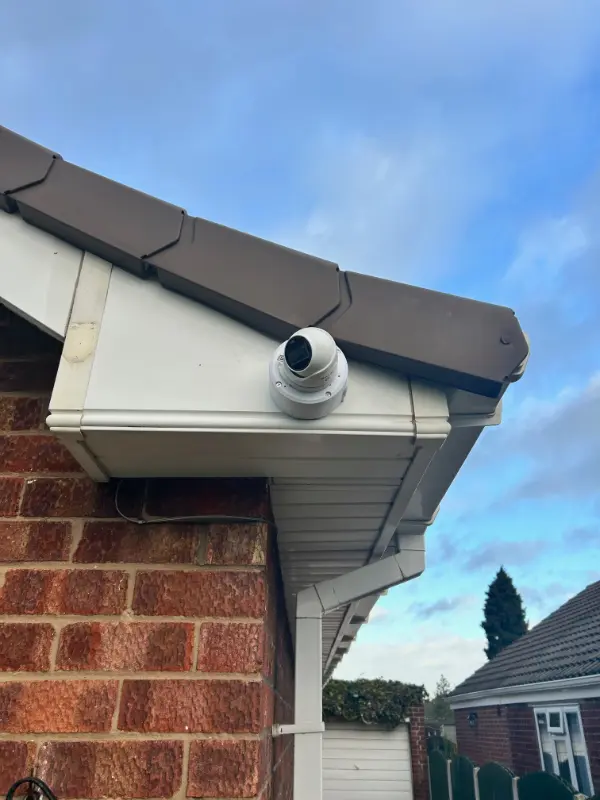
A security camera that produces a blurry or shimmying image during windy conditions is suffering from wind-induced vibration transmitted through the mounting bracket. The problem is most acute for cameras mounted on long arm brackets, on poles, or on the gable end of buildings where wind pressure is highest. In exposed UK locations, wind vibration can render a camera useless during storms, which are precisely the times when security coverage is most important.
How Wind Creates Image Vibration
Wind passing over a camera housing creates both static pressure and dynamic buffeting. The housing acts as a sail, and the force is multiplied by the bracket arm length. A camera on a 300 mm arm bracket in a 50 mph wind experiences approximately 5–8 N of force at the mounting point. This force is not steady; it oscillates at frequencies determined by wind gusts and the natural resonance of the bracket-camera system. When the oscillation frequency matches the camera’s frame rate or a harmonic, the image appears to shimmy. When the amplitude exceeds approximately 2 pixels of movement, the image visibly blurs.
Bracket Design and Vibration Resistance
The bracket is the critical factor in wind stability. A short, rigid bracket with a wide mounting base transmits less vibration than a long, tubular arm bracket. For exposed locations, use a bracket with a triangular gusset or buttress that stiffens the arm against vertical and lateral movement. The bracket should be made of steel rather than aluminium, as steel has approximately three times the stiffness of aluminium for the same cross-section. The camera should be mounted directly to the wall plate rather than on a cantilevered arm wherever possible. If an arm bracket is essential, keep it under 200 mm and use a bracket with a solid core rather than a hollow tube.
Reducing Camera Susceptibility to Vibration
Cameras with electronic image stabilisation (EIS) can compensate for low-frequency vibration up to approximately 5 Hz. Enable EIS in the camera’s video settings if available. Reduce the camera’s exposure time (shutter speed) to 1/120 second or faster; a faster shutter freezes motion and reduces motion blur from vibration. However, faster shutter speeds reduce low-light sensitivity, so this is a compromise. Adding a small weight to the camera housing or bracket changes the resonant frequency of the system, potentially moving it away from the wind gust frequency. A 200 g steel plate bolted to the bracket base can alter the resonant frequency significantly.
When to Re-Position the Camera
If wind vibration persists after bracket stiffening and EIS configuration, the camera position is unsuitable. Relocate the camera to a more sheltered position: under the eaves, in a corner where two walls provide shelter, or on a lower level where ground obstacles break the wind flow. If the camera must cover an exposed area, consider mounting it on a ground-level post rather than a wall bracket. Ground-level posts have a lower centre of gravity and can be guyed with wire stays for additional stability. A post-mounted camera in a sheltered ground position may provide better wind performance than a wall-mounted camera in the same location.

Video: Eufy Security Camera System: The BEST Home Security in 2025?
Frequently Asked Questions
1. Why does my CCTV camera shake in the wind?
Answer: Wind passing over the camera housing creates oscillating forces that transmit through the bracket. Long arm brackets, hollow aluminium mounts, and cameras on exposed gable ends are most susceptible. For more detail, see Offices and Commercial Buildings CCTV - legal-compliance (2026). Also read our related guide: Edge AI vs Server AI for CCTV Processing. Browse our in-depth home security resource at Home Security Guide. Official UK guidance on this topic: ICO.
2. How can I stop my camera vibrating in the wind?
Answer: Use a short, rigid steel bracket with a triangular gusset. Enable electronic image stabilisation if available. Set shutter speed to 1/120 second or faster. Add mass to the bracket to change resonant frequency. For more detail, see Does Schools and Education Settings CCTV reduce insurance premiums in 2026? UK guide. Also read our related guide: Camera Hacking Risks: Default Passwords and Open Ports.
3. What is the best bracket for windy UK locations?
Answer: A steel bracket with a triangular support gusset, mounting base width at least 100 mm, arm length under 200 mm, and solid (not hollow) construction. For extreme locations, use a stainless steel bracket with wallplate mounting. For more detail, see Schools and Education Settings CCTV - cost-guide (2026). Also read our related guide: Encryption Overhead on Older NVRs: SSL Performance.
4. Does electronic image stabilisation help CCTV cameras?
Answer: EIS compensates for low-frequency vibration up to approximately 5 Hz. It is effective for mild wind buffeting but cannot stabilise severe vibration from storms. EIS also slightly crops the image. For more detail, see Can capturing footage of trespassers on a UK construction site constitute a breach of Article 8 rights? UK Construction Sites CCTV rules explained 2026. Also read our related guide: RTSP vs RTMP Streaming for CCTV: Latency and Compatibility.
5. Should I move my camera if wind vibration is a problem?
Answer: If bracket upgrades and camera settings do not resolve wind vibration, relocate the camera to a sheltered position under eaves, in a wall corner, or on a lower level where wind speed is reduced. Also read our related guide: Frame Rate vs AI Detection: The FPS Sweet Spot.
Conclusion
The difference between a security system that works and one that frustrates is understanding the real-world behaviour of cameras, cables, and the environment they operate in. Manufacturers sell specifications. Installers solve problems. The questions above represent the issues that UK homeowners and businesses actually face — the ones the spec sheets do not mention.
Article by Gary Pearce, qualified security systems engineer. For a free security assessment, visit gary-pearce-home-services.pages.dev. This guide was last updated June 2026. Verify current UK regulations with the ICO.